Topography and Geographical Overview
Lucerne sits at an elevation of 436 metres above sea level at the northwestern end of Lake Lucerne (Vierwaldstättersee), where the Reuss River drains the lake basin. The city occupies an asymmetric basin framed by the Mount Pilatus massif to the south (2,128 metres) and Mount Rigi to the east (1,798 metres). Because Lake Lucerne has an intricate fjord-like geometry with four distinct arms, the water-level transport network connects central cantonal valleys directly to alpine footpaths without requiring high-pass automobile transit.
For visitors, this configuration makes Lucerne one of the most operationally convenient bases in the country. The Swiss Federal Railways (SBB) terminal station sits directly across the promenade from the primary passenger steamship docks (Schifffahrtsgesellschaft des Vierwaldstättersees), allowing passenger transfers between heavy rail and historical paddle steamers in under three minutes.
Core Mountain Excursions: Pilatus vs. Rigi
The two primary high-elevation day excursions from Lucerne present distinctly different engineering systems, terrain views, and logistical requirements:
| Parametric Factor | Mount Pilatus (Pilatus Kulm) | Mount Rigi (Rigi Kulm) |
|---|---|---|
| Summit Altitude | 2,128 metres | 1,798 metres |
| Primary Ascent Transit | World's steepest cogwheel railway (Alpnachstad, 48% gradient) | Europe's oldest cogwheel railway (Vitznau, opened 1871) |
| Alternative Route | Aerial cableway via Kriens / Fräkmüntegg | Cogwheel train from Goldau / Cable car from Weggis |
| Terrain Characteristic | Jagged limestone crags, sheer cliff drops, alpine rock | Rolling pastoral meadows, panoramic 360° lake vistas |
| Year-Round Operation | Cableway runs year-round; cogwheel rail is seasonal (May–Nov) | Cogwheel lines operate throughout all four seasons |
The Historic Urban Core
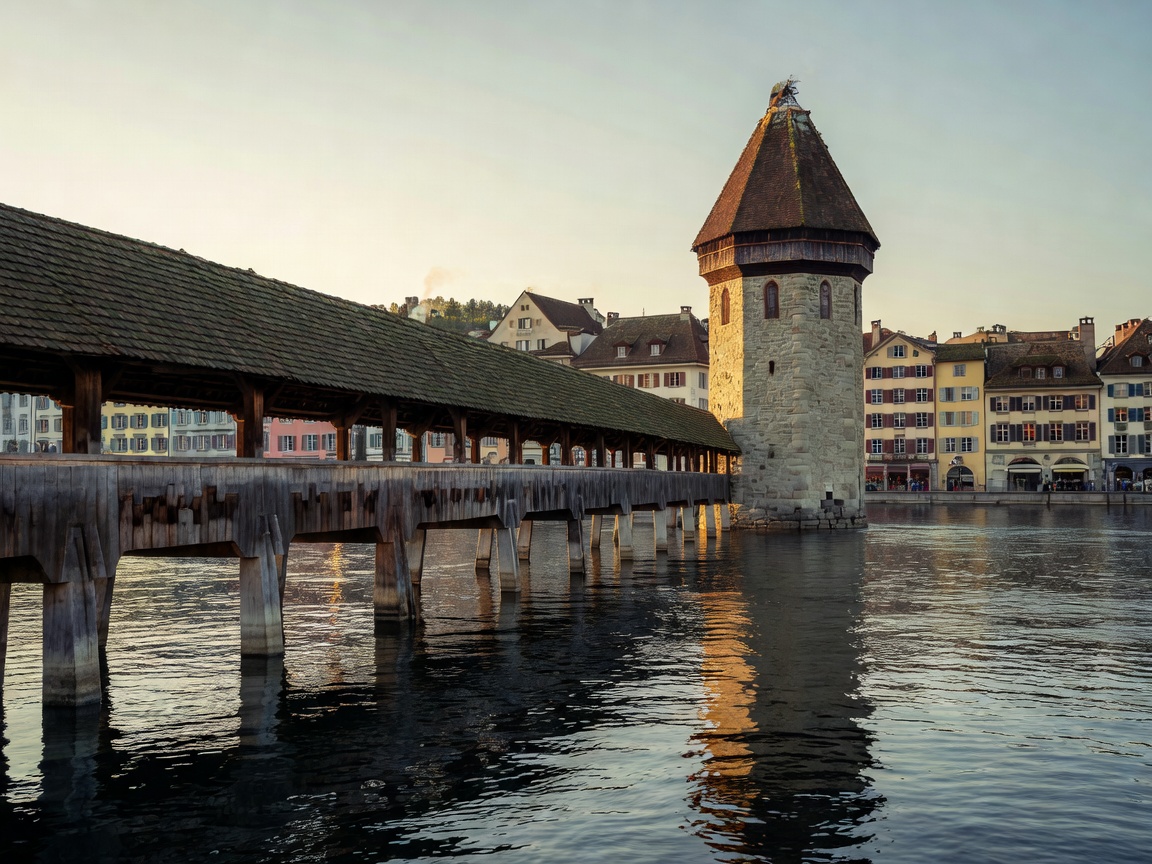
Lucerne’s historical core preserves pedestrian-only streets centered around the Kapellbrücke (Chapel Bridge), a covered wooden truss bridge originally erected in the 14th century as part of the town's defensive fortifications. The bridge features interior triangular roof panels painted in the 17th century portraying cantonal history, alongside the octagonal Wasserturm (Water Tower), which historically served as a treasury, prison, and archive.
Downriver stands the Spreuerbrücke, another covered wooden bridge from 1408 featuring the Danse Macabre (Dance of Death) painting cycle by Kaspar Meglinger. Above the right bank rises the Museggmauer, an intact medieval rampart wall built in 1386 with nine historic towers, four of which remain open for seasonal public foot inspection.
Pros and Cons: Staying in Lucerne
Advantages
- Transit Consolidation: Exceptional railway connections to Zürich Airport (45–60 minutes direct) and direct InterRegio trains over the Brünig Pass to Interlaken.
- Lake Integration: Scheduled paddle steamer routes integrate with mountain trains, enabling the famed "Golden Round Trip" (boat to Alpnachstad, cogwheel to Pilatus Kulm, aerial cableway down to Kriens, and municipal trolleybus back to Lucerne station).
- All-Weather Suitability: If high-altitude cloud cover obscures mountain viewpoints, Lucerne features the Swiss Museum of Transport (Verkehrshaus), the Rosengart Collection (Picasso and Klee exhibits), and the Lion Monument.
Disadvantages
- High Tourist Density: The Old Town waterfront experiences heavy tour coach volume between May and September, particularly around the Schwanenplatz and Chapel Bridge.
- Lower Absolute Altitude: At 436 metres, Lucerne does not experience perpetual snowpack; winter visitors looking for doorstep alpine skiing must transit further into Engelberg (Titlis) or the Bernese Oberland.
Practical Transit & Ticketing Advice
For independent travellers, the Swiss Travel Pass covers the regional lake steamers on Lake Lucerne and the entire cogwheel railway route to Mount Rigi at no additional surcharge. However, ascents to Mount Pilatus via the cogwheel or cableway normally require a separate supplementary ticket (typically offering a 50% reduction for national rail pass holders). We strongly advise monitoring the summit webcam feeds located at Lucerne main station before purchasing cable tickets, as valley morning fog frequently gives way to cloud inversions above 1,500 metres.