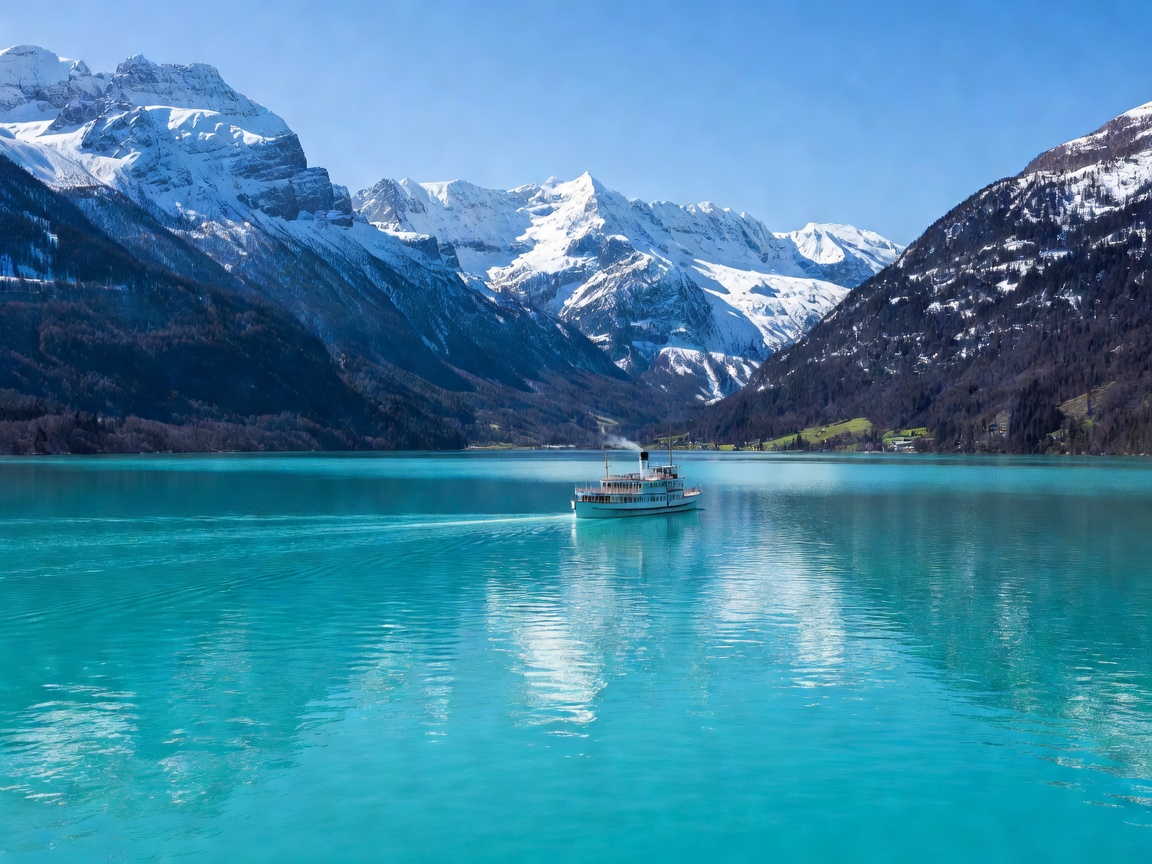
Topography of the Bödeli Plain
Interlaken (historically named Aarmühle until 1891) occupies a unique geographic landform called the Bödeli. The Bödeli is an alluvial isthmus formed over millenia where mountain streams—specifically the Lombach to the north and the Lütschine to the south—deposited glacial silt into what was originally a single massive body of post-glacial water, cleaving it permanently into two distinct lakes: Lake Thun (Thunersee) to the west and Lake Brienz (Brienzersee) to the east.
At an elevation of 566 metres, Interlaken sits flat against the valley bottom, crossed by the River Aare which channels water eastward from Lake Brienz to Lake Thun. The town is flanked on the south by the towering trinity of the Bernese Alps—the Eiger (3,967 m), Mönch (4,107 m), and Jungfrau (4,158 m)—and on the north by the precipitous limestone crest of Harder Kulm (1,322 m).
Lake Dynamics: Thun vs. Brienz
Travellers based in Interlaken have direct access to two distinctly different lake environments, operated by BLS Navigation:
| Parametric Characteristic | Lake Thun (Thunersee) | Lake Brienz (Brienzersee) |
|---|---|---|
| Water Surface Elevation | 558 metres | 564 metres (6 metres higher) |
| Water Color Profile | Deep navy blue, clear alpine lake | Vibrant milky turquoise due to glacial rock flour |
| Key Cultural Landmarks | Thun Castle, Spiez Castle, St. Beatus Caves | Giessbach Grandhotel & Falls, Ballenberg Open-Air Museum |
| Departure Station | Interlaken West Rail Station Pier | Interlaken Ost Rail Station Pier |
Logistical Hub: Interlaken Ost vs. Interlaken West
A crucial operational distinction for any visitor is the difference between Interlaken's two railway stations, situated approximately 1.6 kilometres apart along the central boulevard of Höheweg:
Interlaken West primarily handles national InterCity trains arriving from Bern, Basel, and Zürich, and provides access to the historic retail center and the Lake Thun passenger ship landing stage.
Interlaken Ost is the major alpine rail interchange. From Ost, standard-gauge tracks end and metre-gauge mountain railways begin. The Berner Oberland Bahn (BOB) departs south into the mountains toward Lauterbrunnen and Grindelwald, while the Zentralbahn operates the scenic Luzern-Interlaken Express eastward over the Brünig Pass to Lucerne. The Lake Brienz passenger ferry pier is also integrated into Interlaken Ost.
Harder Kulm & Regional Panoramic Viewpoints
Rising abruptly directly behind Interlaken Ost station is the Harder Kulm funicular railway. In continuous operation since 1908, the funicular climbs a 64% incline in under 10 minutes to reach the summit terrace at 1,322 metres. From the glass-floored Two Lakes Bridge protruding over the precipice, visitors look across both Lake Thun and Lake Brienz simultaneously, with the snow-covered peaks of the Jungfrau, Eiger, and Mönch aligned directly on the southern horizon.
Pros and Cons: Staying in Interlaken
Advantages
- Unmatched Regional Flexibility: If weather systems obscure the high mountain summits, travellers can pivot in minutes to take lake cruises, explore historic castles in Thun, or tour the limestone caverns of St. Beatus Caves.
- Broad Amenity Base: High density of grocery markets, rental equipment providers, and multilingual service points.
- Low Altitude Comfort: At 566 metres, visitors experience no altitude acclimatization challenges while remaining within 45 minutes of high-altitude cable stations.
Disadvantages
- Commercial Density: The town itself lacks the intimate wooden chalet charm of car-free alpine villages like Wengen or Mürren, functioning primarily as a bustling commercial transit terminal.
- High Tour Group Volume: Höheweg boulevard and central transfer platforms can become crowded during peak midday travel hours.
Transit Advice
When heading south into the mountains from Interlaken Ost, check whether your travel is covered under regional transit passes (such as the Jungfrau Travel Pass or Berner Oberland Regional Pass), as mountain trains past Grindelwald and Lauterbrunnen (especially the Jungfrau Railway to Jungfraujoch) require specialized supplements not fully covered by basic Eurail passes.